

 Deutsch
 Français
 Türkçe
Field service
Find guidance for the installed equipment version.

Endurion Atlas makes approved manuals, knowledge articles and internal procedures searchable. Role, context and document version shape retrieval, with draft answers pointing to the relevant passages.
Useful search depends on maintained sources and effective permissions. Both are checked before deployment.

Equipment, version and approval status determine whether technical advice is useful. Atlas is designed to expose relevant sources rather than simply plausible text. If the collection cannot support an answer, that limitation must stay visible.
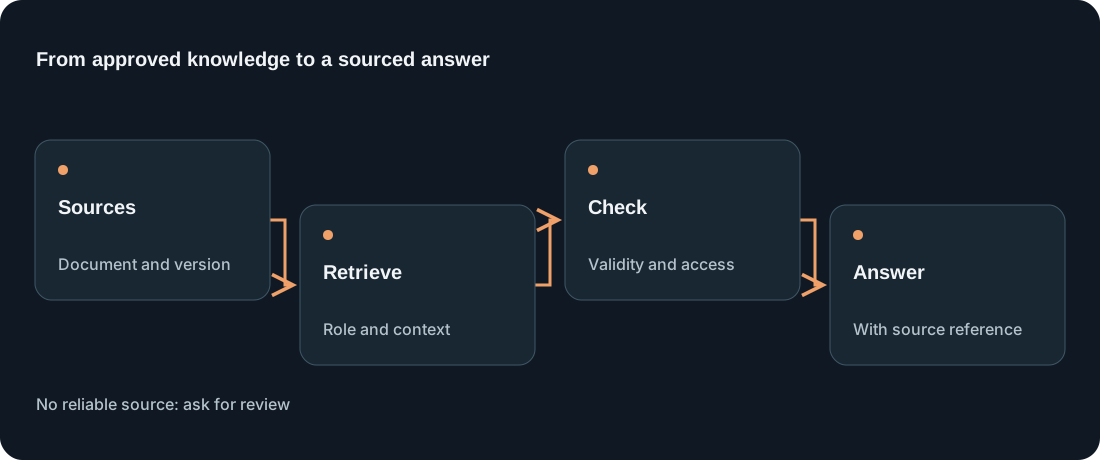
Swipe the diagram sideways. Full step descriptions follow below.
Choose approved manuals, SOPs and articles with a clear document owner.
Structure content, label revisions and add relevant technical metadata.
Find passages relevant to user permissions, equipment and current task.
Display suggestions with source links; escalate uncertain cases to responsible people.
Staff can find verifiable guidance faster. Approved procedures and professional responsibility remain authoritative.
Find guidance for the installed equipment version.
Locate documented incidents and tested resolutions.
Direct new colleagues to the current internal process and policies.
Illustrative scenario, not a customer reference or measured result.
A technical helpdesk searches manuals, procedures and known fixes across SharePoint and file stores. Atlas makes relevant passages discoverable by role and version rather than building another uncontrolled collection.
Discuss your own workflowAsk in chat, search several stores, find an instruction and only then check whether it matches the deployed version.
Search authorised sources in context, show passages with version information and verify the draft answer against the original.
Approved maintenance manuals, internal procedures, technical policies, onboarding material and documented helpdesk fixes.
Search retrieves relevant passages before the model drafts an answer. Sources remain checkable, but a citation alone does not guarantee a correct conclusion.
SharePoint, Confluence or authorised file stores supply content. Identities and source permissions must apply during search and answering. RAG connects retrieved passages to the draft response.
Yes. Checks must apply at retrieval, not only to the visible answer. Role changes and blocked sources therefore form part of acceptance testing.
Search quality depends on sources, freshness and permissions. A language model can draw incorrect conclusions. Without a reliable passage, the answer must be withheld or referred to a subject owner.
Yes. Source checks, uncertainty signals and expert review reduce risk. Questions without reliable evidence require a defined refusal or escalation path.
Endurion separates content sources, indexing, access checks and response logic. Tests cover citations, role changes, outdated documents and questions the source collection cannot answer.
Content owners decide approval and freshness. Synchronisation, indexing and quality checks are technically agreed and do not replace that responsibility.
Change the assumptions. This models potential released capacity, not guaranteed savings or a quote.
Monthly volume × (current minutes − projected minutes) ÷ 60 = hours. Multiply by assumed hourly labor cost for illustrative time value. Implementation, licensing, review and operating costs are not deducted.
Use these answers to define technical prerequisites, remaining review work and the first project scope.
Search retrieves relevant passages before the model drafts an answer. Sources remain checkable, but a citation alone does not guarantee a correct conclusion.
Yes. Checks must apply at retrieval, not only to the visible answer. Role changes and blocked sources therefore form part of acceptance testing.
Yes. Source checks, uncertainty signals and expert review reduce risk. Questions without reliable evidence require a defined refusal or escalation path.
Content owners decide approval and freshness. Synchronisation, indexing and quality checks are technically agreed and do not replace that responsibility.
Permissions apply at retrieval, not just when displaying an answer. Indexing, changes, deletion and old versions need testable rules. Role changes and unanswerable questions belong in the test set.
More about implementationNo. Models can be wrong. We design for citations, uncertainty signals and escalation.
Not necessarily. Architecture depends on existing systems, data rules and permitted access.
Search must only consider approved sources the requester may access. Group and sharing changes must propagate to the index. Indexing a document must not make it visible to everyone.
If Atlas finds no suitable source, the result must say so. Outdated instructions and conflicting versions must not be silently merged. The responsible specialist decides which source should apply.
Let us review your systems, input data and the smallest useful pilot. Final scope and integrations are agreed after discovery.